2 0 2 0 - 2 0 2 5Inspiratorio: a learning platform designed for the team that ran it and the activists who used it.
What a service designer brings to NGO program leadership.
Role: Service designer & Program Lead for Inspiratorio.org | Scale: 2,500 activists · 19 countries · 5 time zones
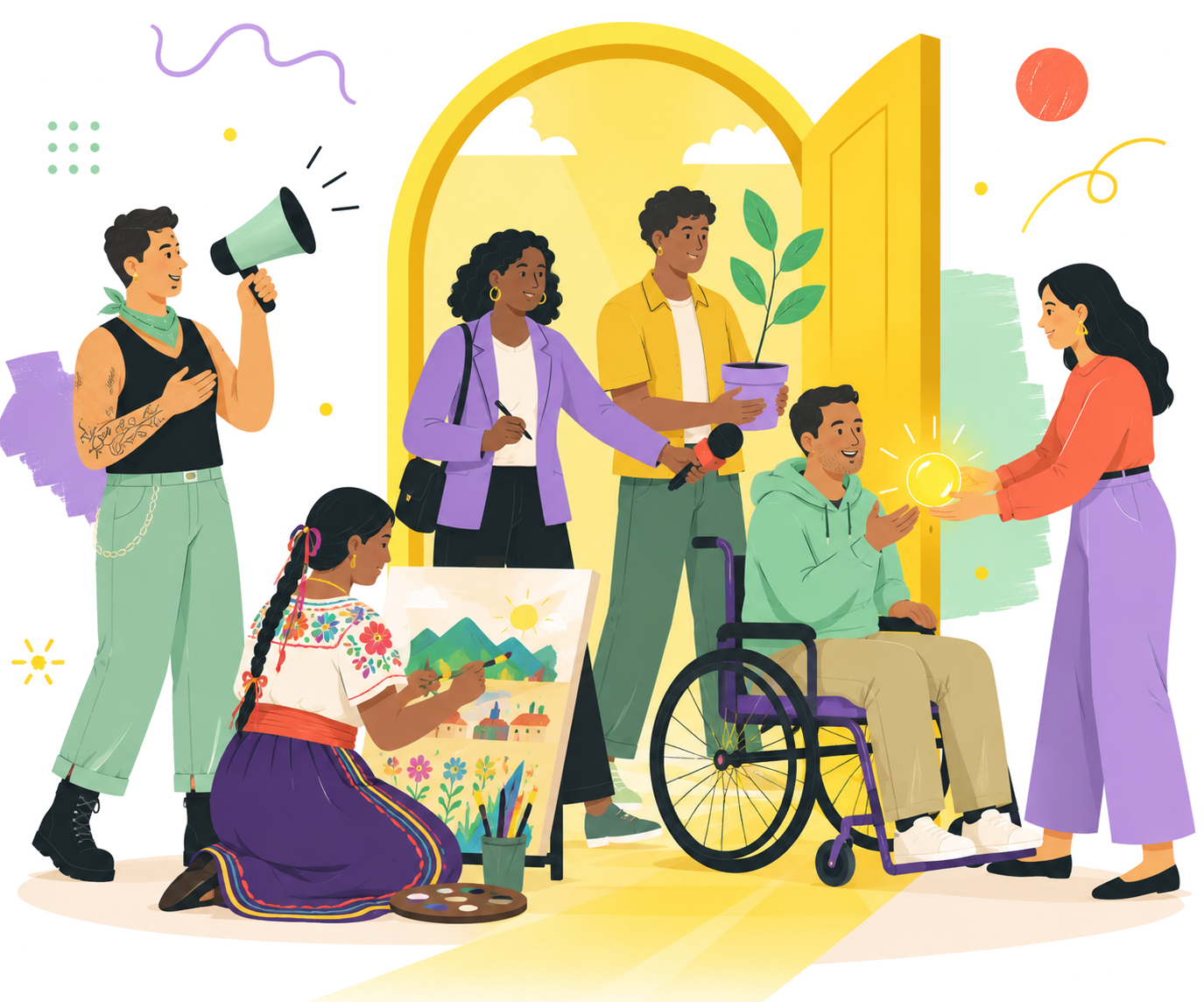
Illustration generated by me with NanoBanana from this reference, and edited on Adobe Photoshop.ContextIn 2020, I was hired by Puentes to coordinate Inspiratorio. My task was to build a learning platform for Latin American activists who wanted to explore advanced cultural change techniques (narrative change). The platform needed to house 10 online learning services (sync and async) and feel like a place where diverse human rights activists across 19 countries in the region could feel at home.
As a service designer I understood I had two sets of users:
my team (which grew in size and complexity each year)
and the end users (activists, which also grew in size and complexity each year).
In five years, I grew Inspiratorio from a contact list of 200 people, to 2,500 active users served by an articulated team-of-teams across 5 time zones.
OUTCOMESGrew from a Colombian pilot to 2,500 participants across 19 countries and dozens of human rights causes.
From 200 to 2,500 in 5 years
Ten services, built while delivering
Ten learning services designed and delivered in parallel over 5 years, on time, on scope, and on budget.
Known among users as a warmer, safer place to experiment than the activist spaces they were used to.
Belonging, by design
Narrative work is a type of culture-change work. Narratives are the shared stories we tell ourselves to explain reality. According to Puentes, sparking large-scale culture change means activists must draw on strategic storytelling, creativity, and collective work.the challengeA scattered movement, in need of collective creativity
When I joined Puentes in 2020, activists across Latin America were stalling. Old strategies had stopped working, and the constant indignation of online activist culture was freezing the creativity new ones require. They were also scattered: isolated across causes, countries, and identities, with little common ground.
Puentes' founder had come to narrative work* from years in strategic litigation, seeing it as a human complement to legal and political change, and founded Puentes in 2019 to bring it to Latin American activists. But narrative change has no settled theory, and what exists is US-built and culturally non-transferable. Users would have to experiment, adapt it to their contexts, and hopefully, share what they found.
So Inspiratorio had to become the thing that made that possible: a place that connected a scattered movement and sparked the creativity it had lost.
*

Coordinating an NGO platform as a service designer
THE DESIGN, PART 1My job as coordinator was to create the scaffolding the platform needed to deliver its services, which were strategically defined by the founder. She decided which services we would run and when; my job was to organise the team to meet the dates and objectives she set. So I treated the team itself as a user group.
As a service designer, I knew a platform where each expert improvised their own delivery wouldn't scale, so I looked for patterns and standardised the workflows, helping the team prepare and deliver in ways users found consistent, and enjoyed. For example, I created a service blueprint for all webinars, mapping the full journey from awareness to retention, including where we'd check whether it was landing. To do that I ran an NPS survey, a light read on whether we were winning people over or losing them. It became the baseline for every service that followed.
This is a visualisation of the original Inspiratorio webinar blueprint. Service blueprints act as scaffolding for digital services, helping the team prepare and deliver in ways users enjoy, value and find consistent.
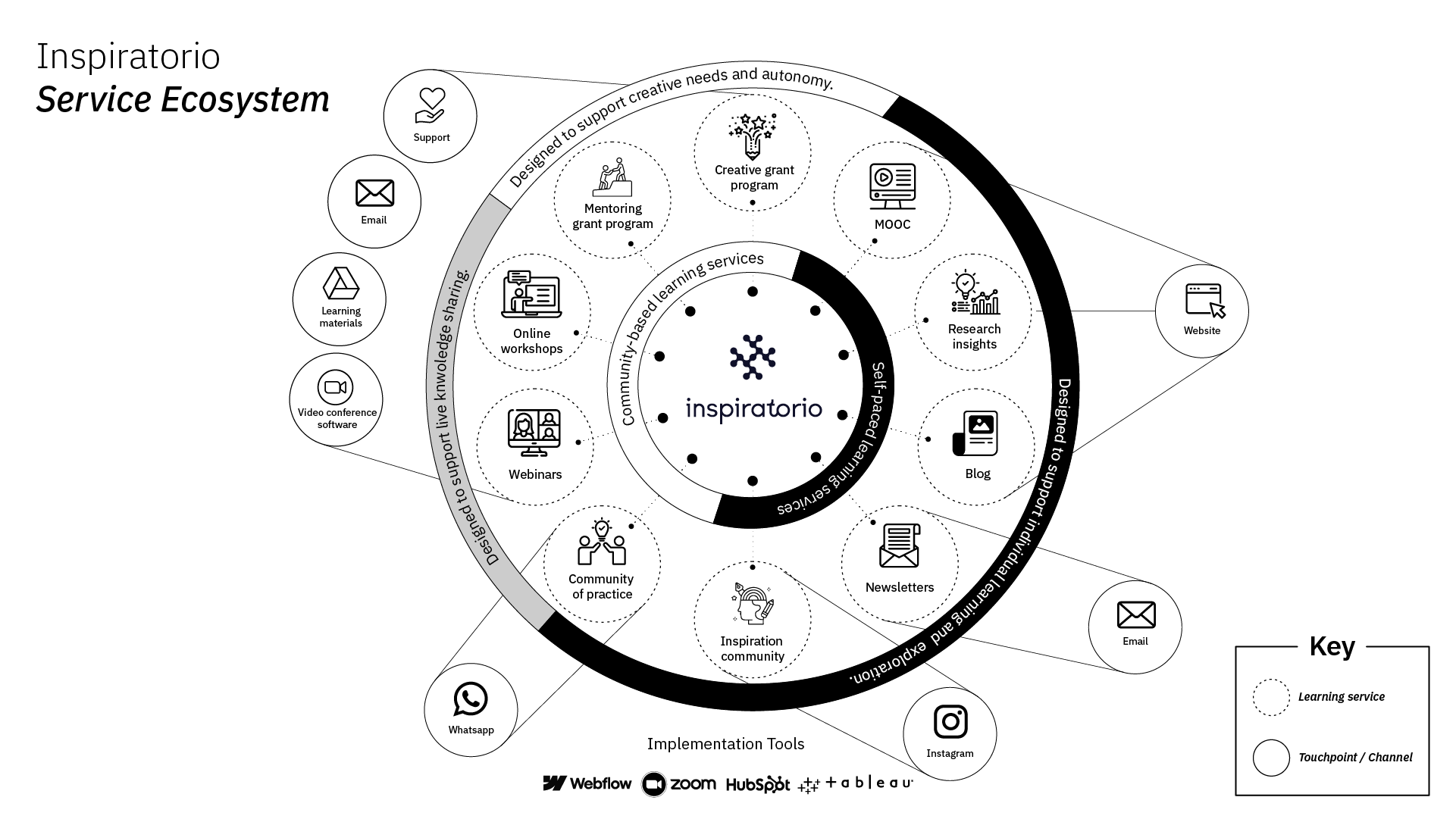
Thanks to the original webinar blueprint, colleagues could adapt it and Inspiratorio scaled into a service hub (ecosystem), annually running 10 sync and asynchronous services for narrative training tailored to diverse learning needs.
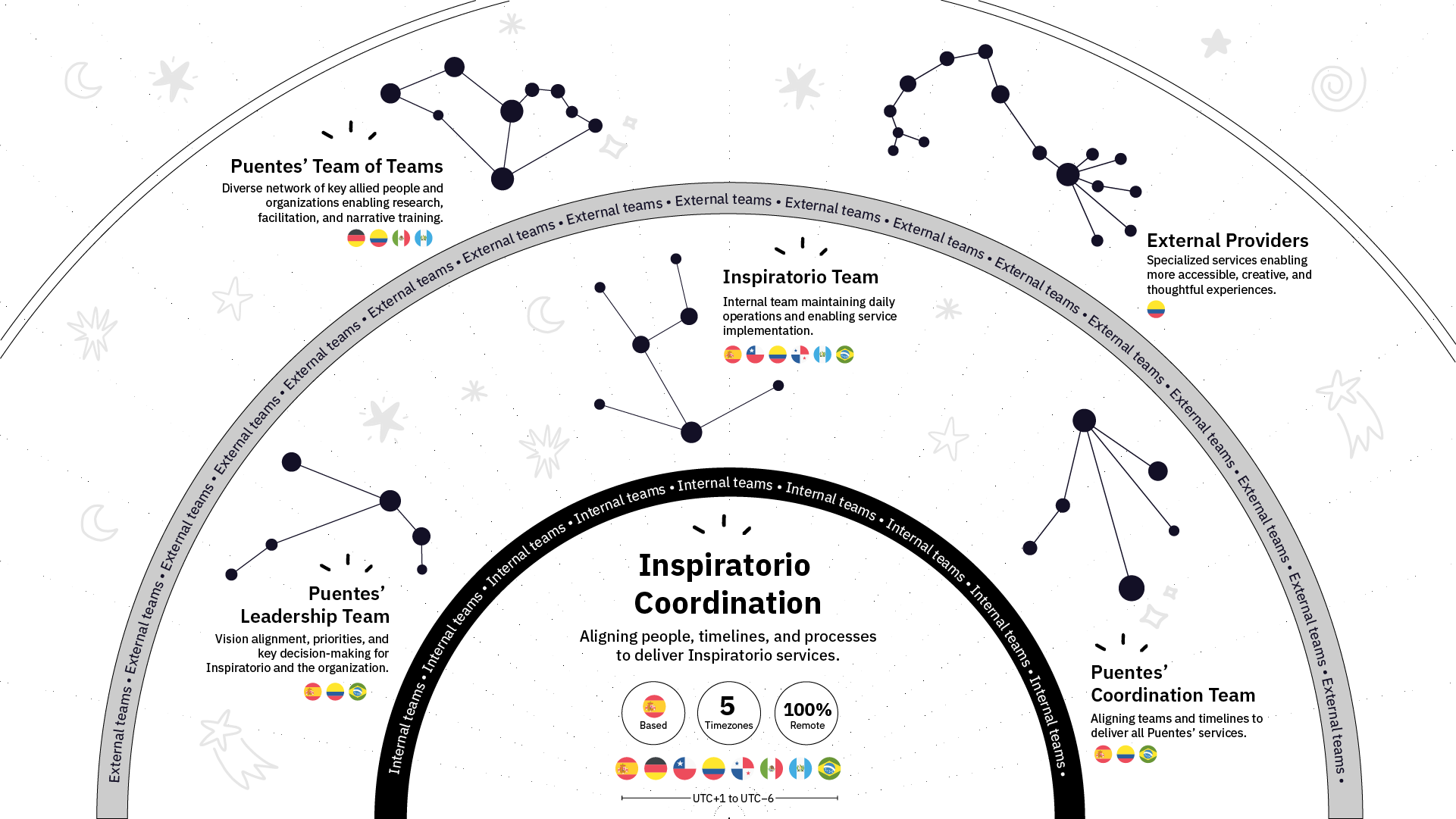
Holding an international, remote team together
I began as the only person designing and delivering, then grew into managing four people plus vendors, negotiating scope across Puentes' other platforms, reporting to both the founder and the Programs Director.
The team was split: leadership in Madrid, operations scattered across Latin America, some with little time-zone overlap. Based in Barcelona, I sat in the gap, generating shared context and linking the people each delivery needed, so a fragmented setup still reached users as one coherent thing. Artefacts such as blueprints and project briefs helped create context based on my colleagues needs, facilitating their work.
THE DESIGN, PART 2Designing for a sense of belonging
“While you can’t design a feeling - feelings are personal- you can learn to recognise how and when those feelings arise and then design all sorts of things that positively influence those feelings: rituals that bring us together, spaces that keep us calm, roles that create a sense of responsibility, systems that make us feel respected, communications that create understanding”
SUSIE WISE (DESIGNER, AUTHOR OF "DESIGN FOR BELONGING")
The power of aesthetics to influence our state of mind
Remember our users’ emotional starting point? Fatigued from hard realities and old strategies that no longer worked. Sensing that doing things differently felt risky.
From my work at OYE I recognised this as apocalyptic fatigue, climate activist Per Espen Stoknes’ term for the freeze doom produces. We know from neuroscience that fear stifles creativity and innovation. We simply can’t think our way out of fear-based states. We need to feel safe. And once we feel safe, we can start playing and creating. And if you want to create change, you have to create something new.
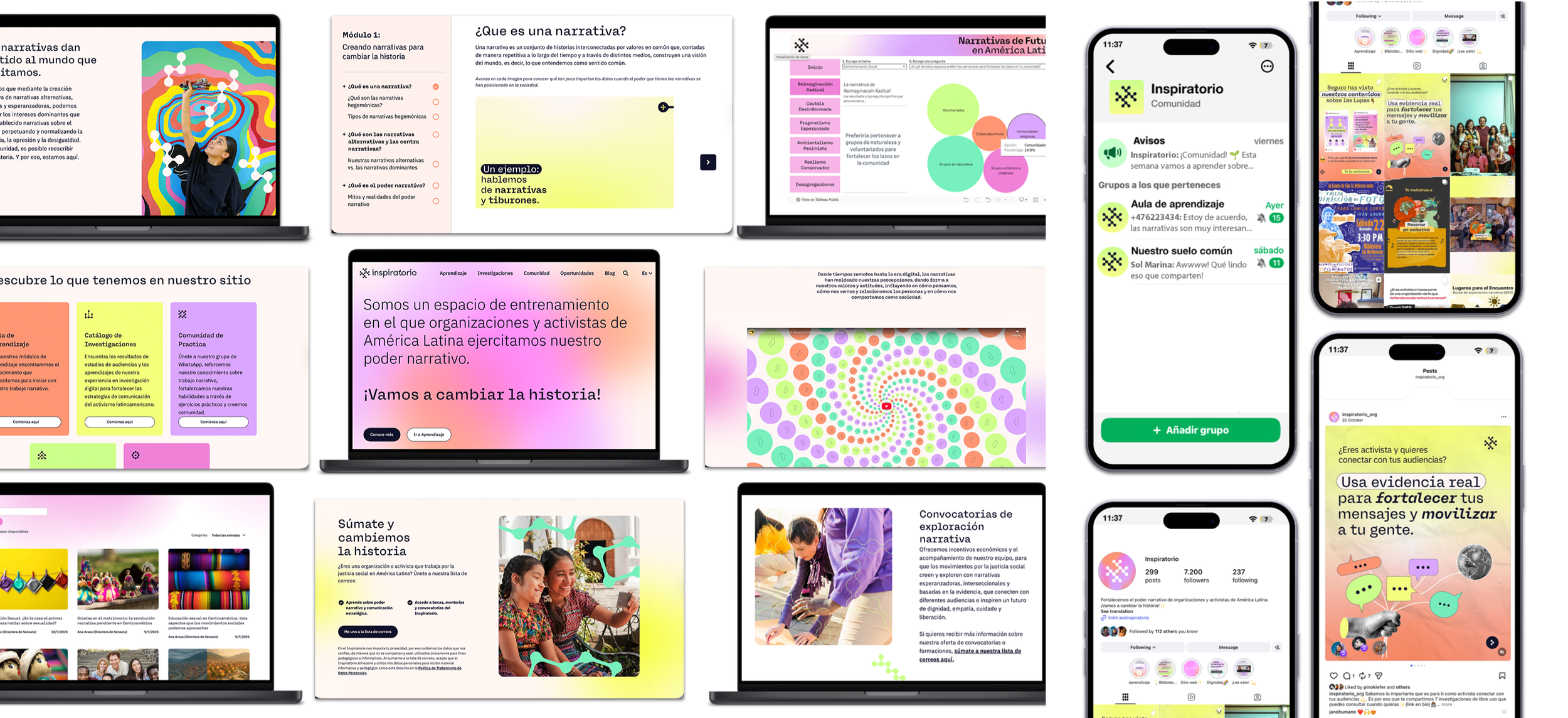
With that in mind, I borrowed from Ingrid Fetell-Lee’s Aesthetics of Joy framework to define the aesthetic concept for Inspiratorio in a way that would reliably spark safety, invoke play, and nudge users from their default critical mode into a kinder, more collaborative, creative state. This aesthetic concept was later translated by a creative agency into the branding you now see at Inspiratorio.
Energy
Lifts mood, enlivens spaces.
→ Bright colours
Play
Sparks safety, creativity and exploration.
→ Rounded shapes, DIY vibes.
Celebration
Amplifies shared joy.
→ Song, dance, fireworks.
“Belonging happens when people feel safe, seen, and accepted”
CHRISTINE WONG YAP (SOCIAL PRACTICE ARTIST)Puentes taught me about belonging
Belonging is something that has to be felt. You can state it all you want, but you have to walk the talk for it to actually work. This is why, apart from staging the services, I designed guidelines for the relationships and interactions between people at Inspiratorio (host-to-participant, host-to-expert, participant-to-participant, etc.).
For example, users had to trust that they could enter as themselves, without shedding what made them different. A host colleague created a video to share at the beginning of every webinar stating that cameras are optional, chat is available, and accessibility services are available, and, as a bonus, reminding us that distractions are normal, since we're all probably connecting from home with pets, children, or other family nearby.
Why belonging?
My hope was simple: that if people this different could feel they belonged at Inspiratorio, their faith in the kindness of humankind might be rekindled enough to keep them open to learning, experimenting, and staying in the fight. Defending human rights is tough work.
So, what happens when a service designer is hired to coordinate, not just design?
LESSONS LEARNEDFour things came out of this role that I'd bring to the next:
I don't just keep the work moving; I design how it feels. Like any good project manager, I can get a team and its vendors to deliver on time and on scope. What I add is a service designer's eye: at Inspiratorio I didn't just make the platform work, I designed how it felt, so delivery produced an experience people trusted, not just services that shipped.
I treat the team as users. I design the internal tools, context docs, meetings, workflows, as products with people who use them, so coordination makes the work easier instead of adding bureaucracy.
I find my leverage fast. The services and roadmap were set before I arrived, so I focused on what I could move, using what I knew about the audience from OYE plus close observation to add value without waiting for everything to be defined.
I find honest signal with limited resources. I treat measurement as worth doing even when it has to be lightweight, guarding against biases that mislead. I know how to get a real sense of user needs and perceptions with what's available.
A final, honest note:
I'm grateful for Puentes; it taught me what it takes to build and fund something as ambitious as narrative power for Latin America, and how to lead across cultures, languages, and identities. It was also a hard role. As the only person with a design background, I sometimes struggled to make the value of design legible to leadership, and I learned that fighting for that value is part of the job almost everywhere.
The clearest lesson: social impact and user impact are not the same thing. User impact can be mistaken for vanity metrics. It should always be clear it is about making sure you're actually making something that is valuable and desirable for a specific set of individuals, not just something technically feasible. Social impact is the broader, community-level impact. Both should be measured, but differences should be clear.