CivicTech / Human Rights
Service Design
Program Coordination
Inspiratorio.
Designing the way into Latin American narrative change.
Lorem ipsum dolor sit amet, consectetuer adipiscing elit, sed diam nonummy nibh euismod. Lorem ipsum dolor sit amet, consectetuer adipiscing elit, sed diam.

Introduction
Inspiratorio is a free online learning community for human rights communicators and creatives across Latin America. It is part of Puentes’ network of platforms advancing narrative change across the region. The two most established are Familias:Ahora (reconciling traditional family values with progressive ones) and CREO (bridging faith communities and progressive movement). Within that ecosystem, Inspiratorio serves as the onboarding layer*: the platform that takes curious but skeptical newcomers and converts them into practitioners ready for deeper work. The hard part wasn't just teaching skills. It was that narrative change required our users to abandon ways of working they'd held for years, and most had no reason to trust us enough to try.
*
None of us called it “onboarding” back then. That framing came later, as I began to see the work through a product lens.I led Inspiratorio from concept to scale over five years (2020-2025), first as its sole designer, then as the lead of a cross-functional remote team of nine.
My role
Human rights communicators, activists, and creatives across Latin America, most of them working in under-resourced NGOs, underserved by English-centric narrative-change resources.
Target users
These users needed to learn narrative-change skills but lacked resources in their own language and cultural context, and carried active resistance to being taught by outside experts.
Challenge
Activate newcomers into narrative-change practice and graduate them into Puentes' campaign platforms (Familias:Ahora and CREO), building a self-sustaining pipeline of practitioners across the region.
Project goal
Onboarding into narrative change practice requires shifting long-held behaviors.
FRAMING THE PROBLEMNarrative change requires learning specific skills, but it also requires people to work in ways most NGOs aren't set up for: collaborating across causes, experimenting without certainty, treating creativity as strategy rather than decoration. Onboarding into narrative work wasn't just a knowledge gap. It was a behavior-change problem. Our users had to unlearn ways of working before any new practice could take root. Funder structures, years of siloed work, and a long history of international experts prescribing solutions that ultimately failed had made these defaults rational.
The real work became building a learning platform while at the same time engineering the conditions under which unfamiliar, uncomfortable behaviors become possible.
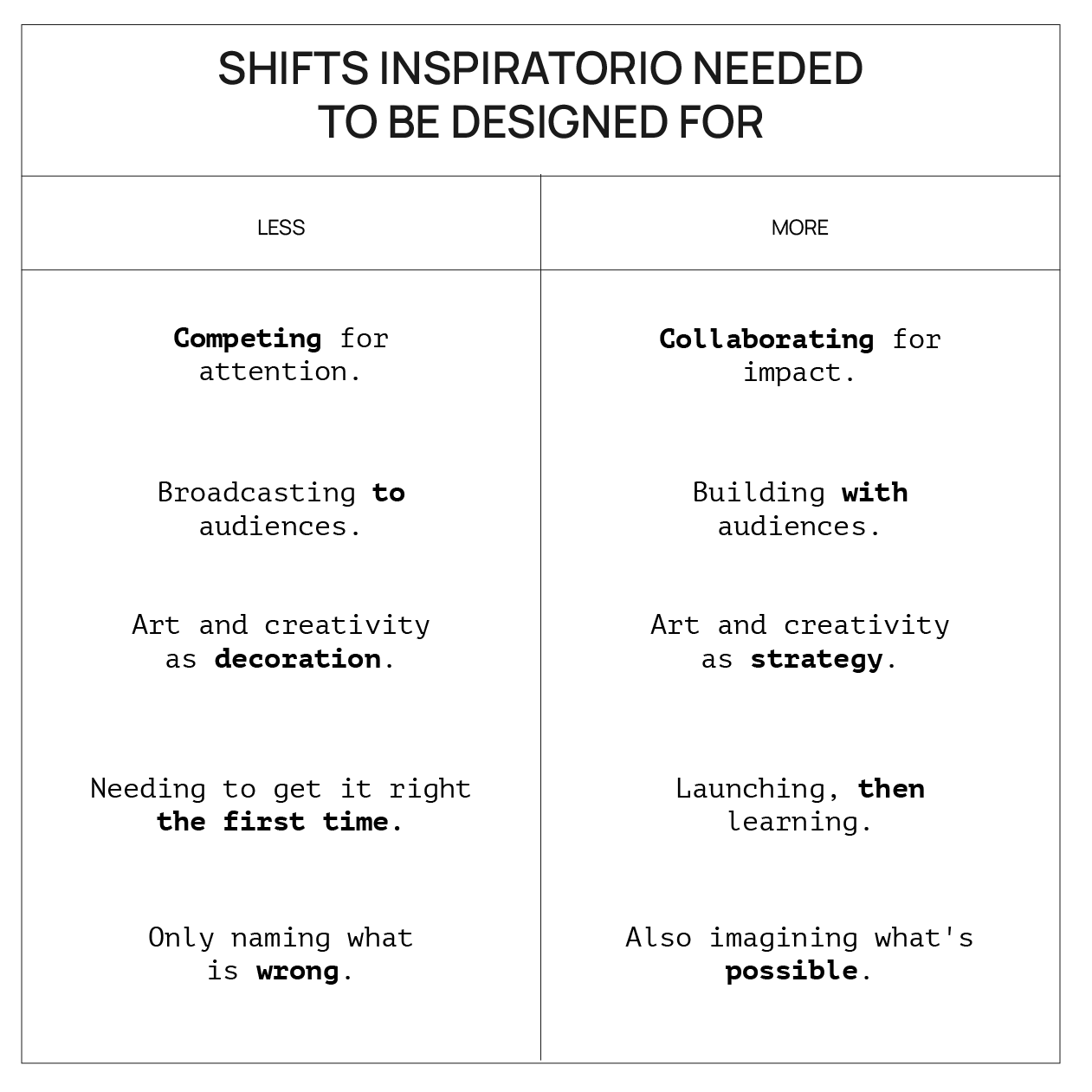
USER RESEARCHWhat do users need to engage with online narrative change learning?
Research techniques: online survey (N=50), 10 in-depth interviews, and desk research (guerrilla research*) with participants from a Puentes-operated WhatsApp group of activists across Latin America.
KEY FINDINGSA bridge across generational divides. Both veteran communicators and younger practitioners carry valuable knowledge. They need a structure that makes exchange possible without either generation having to defend their approach.
Psychological safety before participation. Silence in this community was not apathy. They need environments where the rules of engagement are clear and the audience is known before they can contribute meaningfully.
Controlled spaces for sensitive knowledge. Strategic and opposition research work cannot happen in open, unmoderated groups. They need formats where privacy is designed in, not assumed.
Credibility that comes from within their world. Outside expertise is only usable when it arrives through someone already trusted. They need curators, not just teachers.
Permission to experiment, built into the format. High-stakes contexts make risk feel unaffordable. They need learning experiences that model iteration as a practice, not just preach it as a value.
Inspiration before instruction. Apocalyptic fatigue had narrowed their sense of what was possible. Before new tools can land, they need an encounter with a different way of seeing the work entirely.
*
I chose guerrilla research due to time constraints, but implemented feedback loops on the solution to keep learning and building user knowledge.“
JOBS-TO-BE-DONE STATEMENTWhen I'm frustrated from the challenges of high-stakes advocacy work and skeptical of advice that wasn't built for my context, I want to encounter fresh perspectives from people who understand what's actually at stake, so I can leave with a new way of seeing my work rather than just a new set of tools.
THE SOLUTIONInspiratorio as a trusted introduction to narrative practice.
We started Inspiratorio as an online conference. Puentes' Executive Director, already trusted by the community, curated a roster of international experts. I designed the full experience across pre-event, event, and post-event phases, with a specific energy and tone calibrated to users' emotional state.
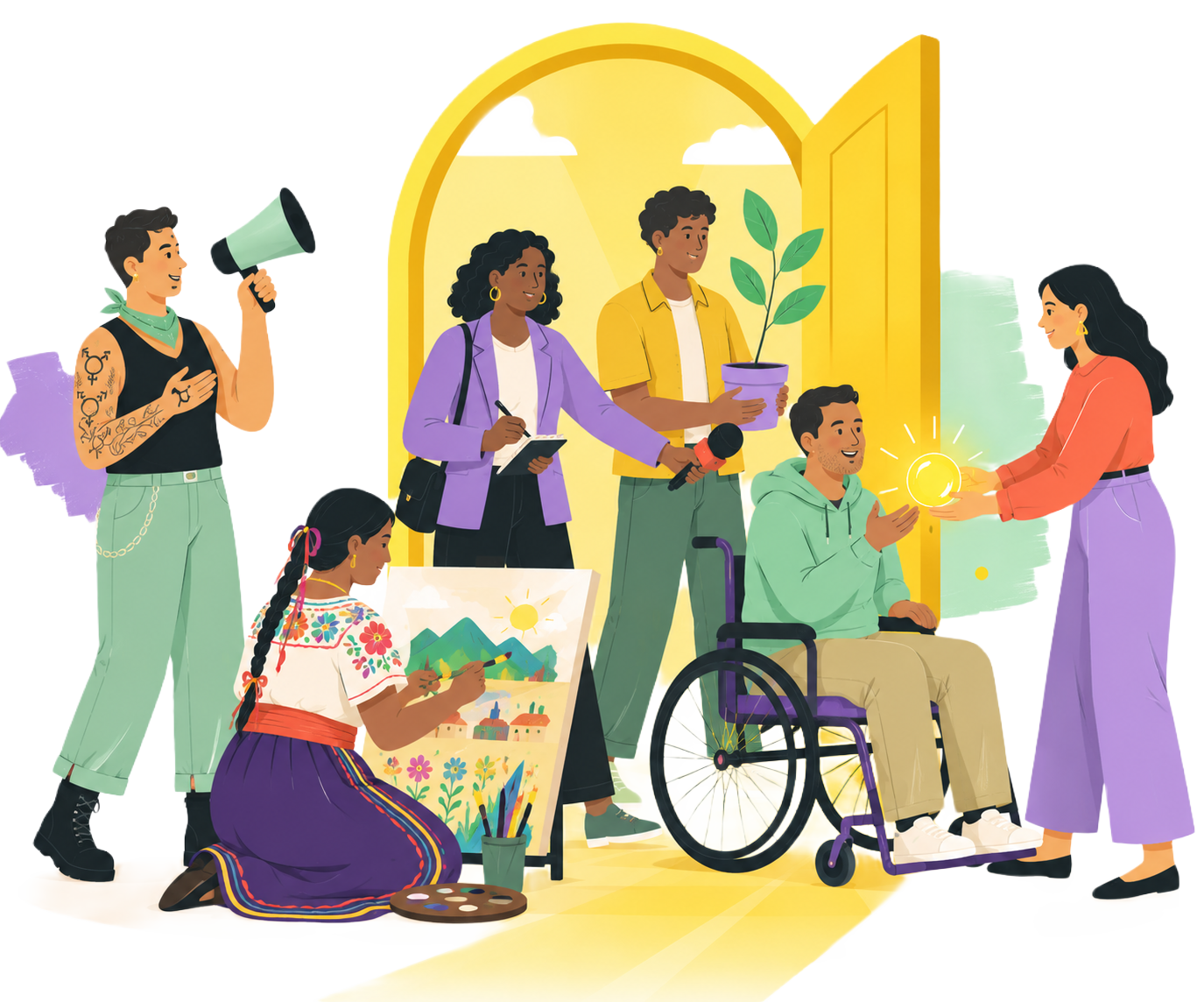
The goal was to open a door into different perspectives about narrative practice, so people could use their own best judgement to make narrative change practice their own. This would build the mindsets needed to actively participate in other Puentes’ platforms.
THE SOLUTION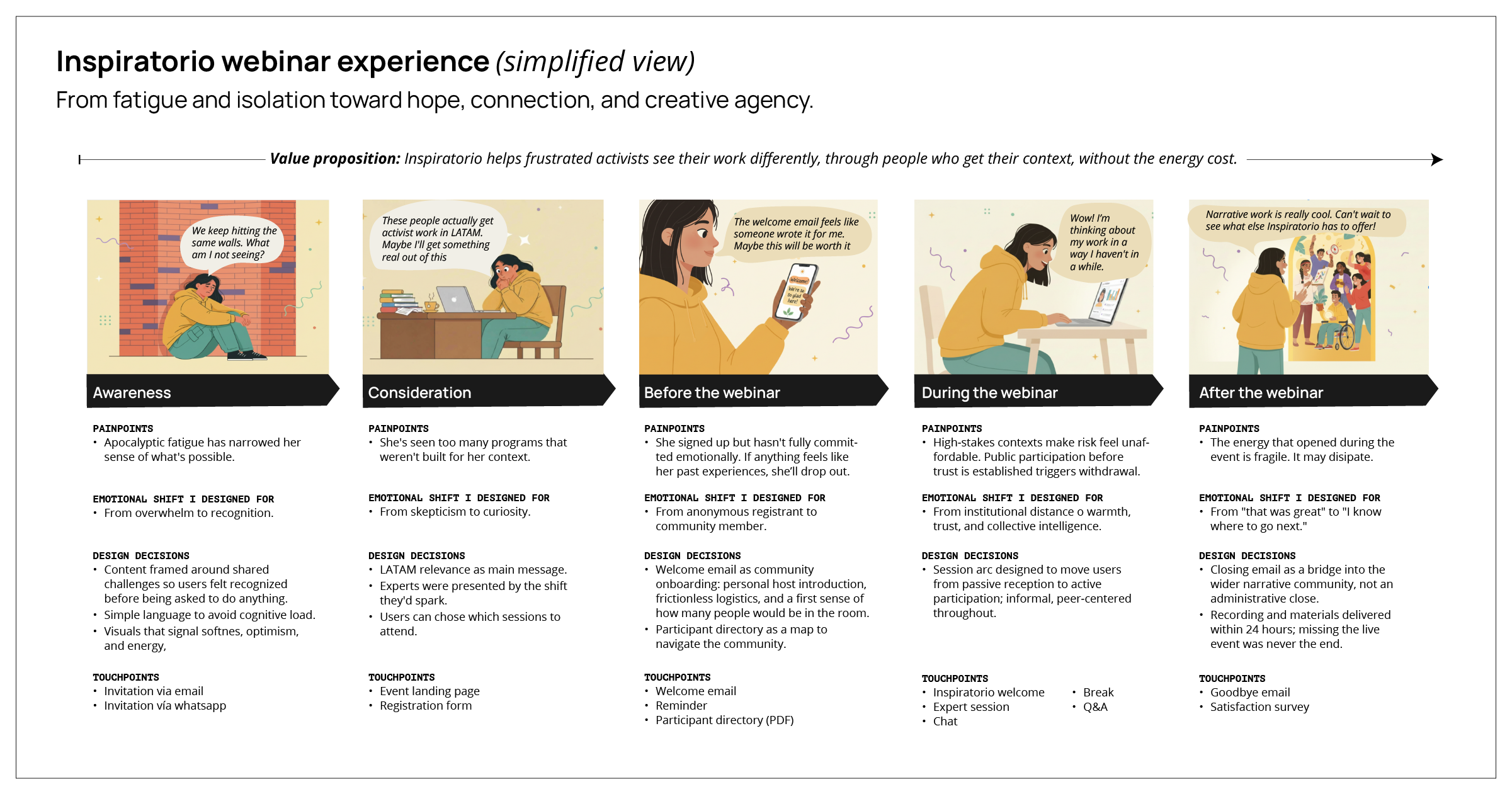
Touchpoints designed
Emails
Participant Directory PDF
Landing Page
Presentation slides
Icebreaking activity
Music
Chat messages
Satisfaction survey

The Pivots: how Inspiratorio grew from scattered webinars into a full, coherent learning ecosystem
VIZ IDEA
Cards for each webinar (show that they became the online trainings + NLU)
Ecosystem diagram